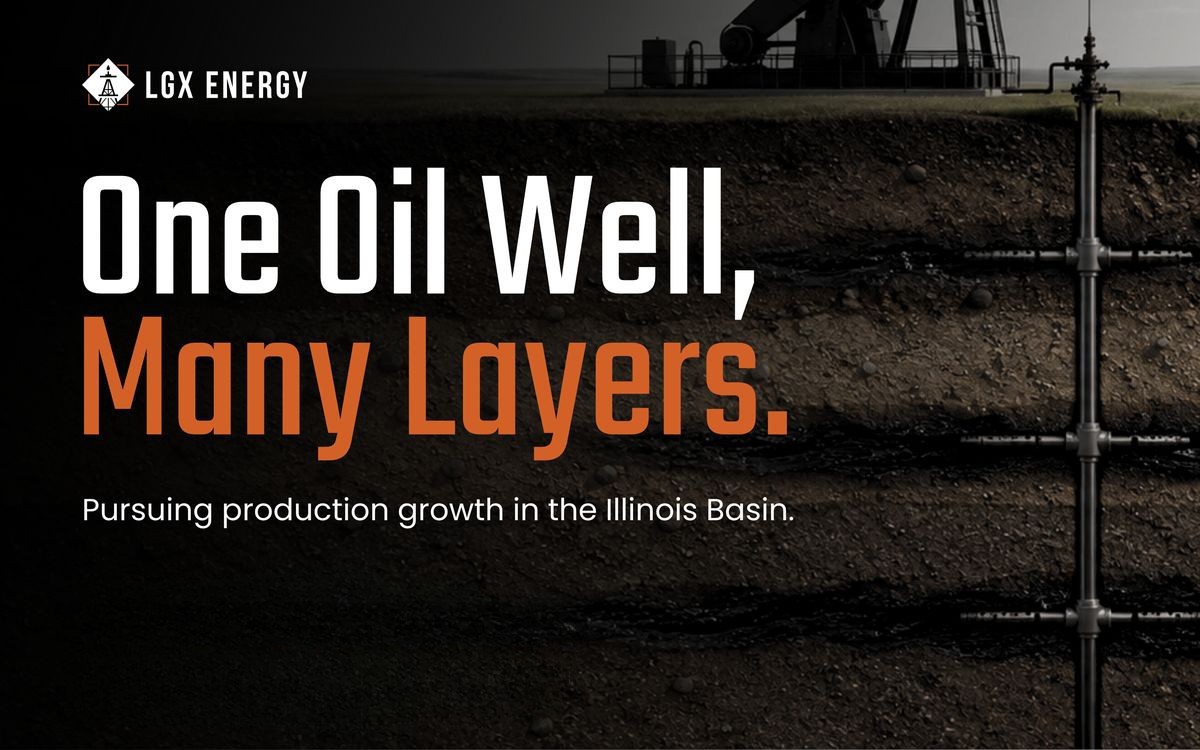
In 1885, a driller near Lima, Ohio, went looking for natural gas and hit oil instead, in the Trenton limestone at about 1,250 feet.1 Within two years, the Lima-Indiana field, spreading from northwest Ohio into east-central Indiana, led the world in production.1 John D. Rockefeller bought much of it at bargain prices, built a refinery at Whiting on the Indiana lakeshore, and fed the crude into the company that made him America's first billionaire.1 The rock at the center of that story was the Trenton limestone, and it still runs deep beneath Indiana.
That history sets up a plain question. If Indiana sits on proven oil trends, why do larger companies in the world leave Indiana oil to independent operators? The answer is not the geology. It reflects who owns the land.

The Formation That Built a Fortune
The Lima strike opened the Trenton limestone to a generation of drillers. By 1887, the Lima-Indiana field was the largest oil producer on earth.1 The oil was sour and heavy, so Rockefeller acquired wells cheaply and stockpiled roughly 40 million barrels while his chemists solved the sulfur problem. Herman Frasch patented a desulfurization process in 1887, Standard Oil broke ground on the Whiting refinery in 1889, and by then the company controlled most of the territory around Lima.1 The boom sat in east-central Indiana and northwest Ohio, a different corner of the state from where LGX works today. The formation, though, is the same one that produces oil from fields drilled sporadically across the Illinois Basin and is consistently present across the areas of Indiana targeted by LGX.
Why Big Oil Is Not Assembling This Ground
LGX Executive Chairman Howard Crosby traces the opening to how the land was first settled. Southwestern Indiana, he says, "was settled over 150 years ago under the Homestead Act, and so the properties are broken into small tracts of land." The result is a checkerboard of family farms, and "it's not possible for an oil company to get, say, 10,000 acres of prospective land with a single signature like in Texas."
The survey record backs the pattern. The federal rectangular survey divided the ground into 640-acre sections, then quarter-sections of 160 acres and smaller parcels, and the land passed to individual farmers in modest lots.2 Two centuries later, that map still decides who signs a lease.
A major oil company is built to move on large, contiguous blocks. Assembling ten thousand acres through one negotiation justifies its overhead. Stitching the same position together out of hundreds of separate farm leases does not. So, the big operators tend to pass over the southwestern Indiana oil trends, even though the ground has proven oil charge. The region has yielded close to 388 million barrels across its history, roughly 70 percent of Indiana's total, according to public state and geological records.3
The Advantage of Being Small and Local
The fragmentation that repels a major is workable for an operator built for it. LGX says it assembled roughly 7,000 acres by signing 220 separate leases with small tract landowners and farmers, using a local team that knows the ground and the people on it.4 That is the moat. It is not a patent or a secret. It is intense door-to-door leasing, seismic work, and years of building a rapport in the local community. LGX holds an advantage with a large inventory of existing drilling prospects, having acquired and reprocessed extensive 2D seismic data throughout proven Indiana oil trends. In knowing which lands to target for its leasing efforts, LGX can give focus to specific areas with limited competitors, who are not able to replicate where to lease quickly.
LGX utilizes 3D seismic to lower risks before drilling any oil prospects in Indiana. Leasing and drilling, however, carry their own risks, and acquiring acreage is not the same as producing oil from it. What the land structure gives LGX is room to build a position without a larger company bidding against it.
The Trenton, Underfoot Again
The same Trenton limestone that fed Standard Oil runs deep beneath LGX's southwestern acreage, one of the deeper formations in the region's potential stacked oil pays. For LGX, it is an unproven deeper target, not a producing asset. Any estimates the company holds for it are based on surrounding oil field analogs and internal estimates, made before drilling, and having not been confirmed by a third-party reserve review. History is a reason to look at the rock, not a promise of a barrel from it.
What It Means if You Are Weighing the Offering
The moat here is structural, and the history is real. Neither is a forecast of return. LGX Energy is conducting a private placement, supported by Regiment Securities, available only to verified accredited investors. The investment is speculative and illiquid, and a complete loss of principal is possible. If the setup interests you, read the offering documents, including the risk factors, and decide for yourself.
Footnotes
- "Great Oil Boom of Lima, Ohio," American Oil & Gas Historical Society: 1885 discovery of oil in the Trenton limestone at ~1,252 feet; Lima-Indiana field led world production by 1887; Rockefeller / Standard Oil acquisition, ~40-million-barrel stockpile, Frasch desulfurization (1887), and the Whiting refinery (1889). aoghs.org/petroleum-pioneers/great-oil-boom-of-lima-ohio
- "Indiana Land Surveys: Their Development and Uses" (AY-237-W), Purdue University Extension: the Public Land Survey System, 36-square-mile townships, 640-acre sections, 160-acre quarter-sections and smaller parcels, survey completed around 1834, and the resulting pattern of small individual ownership. extension.purdue.edu/extmedia/ay/ay-237-w.pdf
- Oil and gas field production data for Indiana via the Kansas Geological Survey / AAPG (2003): approximately 388 million barrels produced from southwestern Indiana, about 70 percent of the state total. kgs.ku.edu/Midcarb/Documents/AAPG-May-2003/Oil&Gas_Fields_Indiana.pdf
- LGX Energy company statements (acreage and lease counts).